


The ‘Human-in-the-Loop’ Protocol: How AI Enhances, Not Replaces, Attorney Expertise

If you’re looking to bring more efficiency to your firm’s content marketing efforts, few tools hold as much promise as artificial intelligence. Whether you’re drafting blog posts, generating ad copy variations, or creating an email sequence, AI can save you and your team countless hours of initial effort.
Unfortunately, this efficiency can come with a significant risk no legal marketer cannot afford to ignore. The “hallucination” problem, when generative AI produces plausible but factually incorrect information, poses serious ethical and reputational threats. High-profile cases, such as Mata v. Avianca, where lawyers were sanctioned for citing AI-fabricated case law, demonstrate just how high the stakes are.
So how can your firm avoid falling victim to the 5–10% error rate common in today’s AI models? I suggest implementing a Human-in-the-Loop (HITL) protocol: a defined process where a human expert—whether a lawyer, marketer, or analyst—validates, corrects, and provides feedback on all AI-generated material before it’s published. While some might consider these extra steps a hindrance to efficient content production, I view HITL as a mandatory compliance safeguard that no legal practice can do without. After all, the real value of AI isn’t in replacing expertise; it’s in freeing your experts to focus on the high-value judgment and oversight that only humans can provide.
The Data-Driven Rationale for Oversight
Implementing a robust HITL protocol isn’t just about avoiding mistakes, it’s about achieving better outcomes. What’s more, the data clearly shows that leveraging AI in combination with human creativity and expertise is essential for both compliance and content performance.
The Accuracy and Compliance Imperative
Generative AI is built to be predictive and fluent, not perfectly accurate. Its main goal is to churn out text that sounds correct. Data increasingly suggest this resulting lack of accuracy and overall page authority leads to what might be called an “accuracy tax” that can negatively impact both online visibility and engagement:
- Human content produces 41% longer session durations and 18% lower bounce rates than AI-only content.1
- Human-authored content generates more than five times the traffic within five months than AI-generated material.2
- Content reviewed by humans ranks about 23% higher on average than unedited AI-generated pieces.3
For your law firm, the danger inherent in purely AI-generated content extends far beyond mere underperformance in search rankings or client engagement. You also risk running afoul of the American Bar Association’s Model Rules of Professional Conduct:
- Rule 7.1 prohibits any “false or misleading communication” about a lawyer’s services.
- Rule 5.3 requires partners and supervising attorneys to ensure that the conduct of non-lawyers, including AI systems, aligns with professional obligations.
The only way to ensure your firm’s remains in compliance with these ethical requirements is to subject every piece of content generated by AI to a thorough human review.
Mitigating Algorithmic Bias in Targeting
Inaccuracies and ethical non-compliance aren’t the only risks associated with the unchecked use of generative AI. Because these models learn from historical data, any biases contained in that data can be replicated—and even amplified—by the system. This can lead to discriminatory outcomes in areas like ad delivery or lead scoring, where AI-powered tools might inadvertently favor one demographic over another.
To prevent this, data analysts should regularly audit AI-powered targeting systems on platforms such as Google Ads and LinkedIn. By reviewing anonymized demographic data, you can help ensure campaigns remain compliant and avoid potential claims of discrimination.
This approach also aligns with emerging global standards, including guidance from UNESCO and regulations such as the EU AI Act, both of which emphasize the importance of human oversight to mitigate bias in algorithmic decision-making.
Building a Structured HITL Protocol for Your Firm
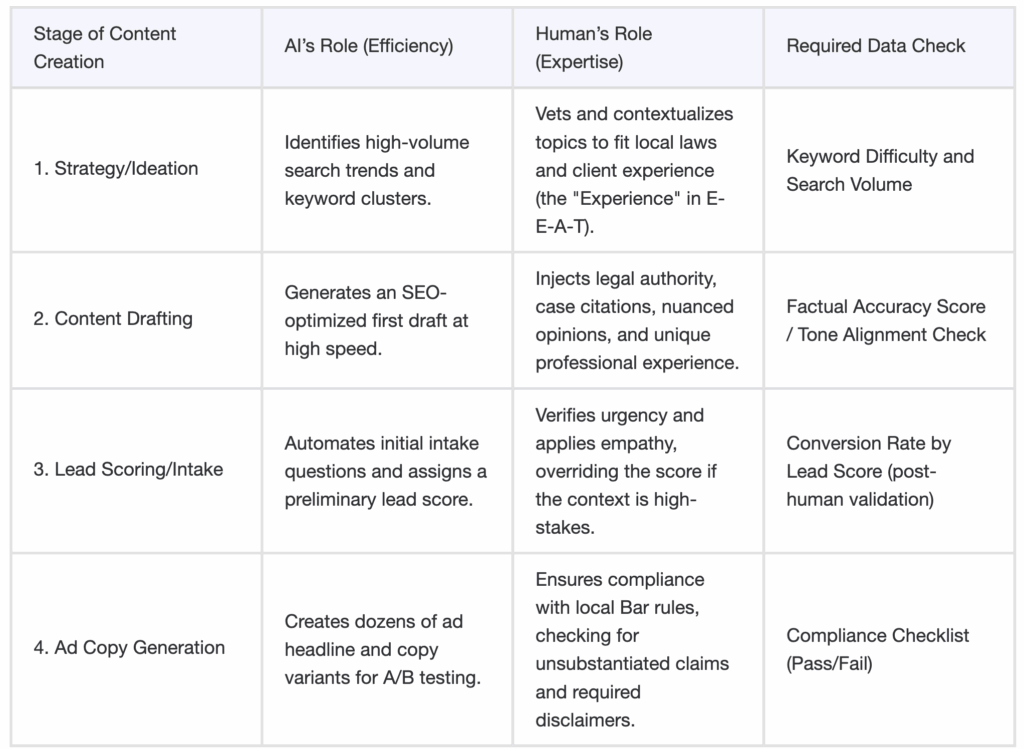
How do you integrate this mandatory oversight without grinding your marketing workflow to a halt? The key is to define clear roles for both AI and your human experts at each stage. I suggest using the following framework:
Measuring the Value of Human Intervention
Hopefully, I’ve convinced you of the value inherent in an HITL protocol.
But how can you get buy-in from skeptical stakeholders who question whether the advantages to be gained from a human review actually justify the added time or cost? By measuring the performance difference between purely AI-generated outputs and those overseen by a human:
- Metric: Accuracy/Error Rate: Track the percentage of critical errors (legal inaccuracies, compliance breaches) caught and corrected by your human reviewers. A low internal error rate means your systems and prompts are improving, while zero published errors mean your protocol is succeeding.
- Metric: Content Engagement Depth: Compare two similar blog posts: one with low HITL versus one with full attorney review (high HITL). Track metrics like Time on Page and Scroll Depth. Deeper engagement signals higher-quality, more authoritative content that resonates with your audience.
- Metric: Conversion Quality: Analyze the lead scores from a fully automated intake process against those manually validated by your intake team. The goal is to prove that human judgment results in a higher percentage of qualified, signed cases, demonstrating a direct impact on your bottom line.
Elevating the Attorney’s Role in the Age of AI
AI will never replace a lawyer’s expertise, but it can replace the grunt work. In the end, the future will belong to law firms that use AI responsibly, not only for speed, but also as an accountable and well-supervised assistant.
Ready to implement a responsible AI-driven content strategy? Start with a simple HITL protocol for one sensitive piece of content, such as your “Contact Us” page or FAQ section. Then track the results for 30 days. The data will speak for itself.
Need support? Reach out to us today to learn how our team can help.
Sources:
- Draymor (2025). “AI vs. Human Content: Which Performs Better in 2025?” https://draymor.com/blog/ai-vs-human-content-which-performs-better-in-2025
- Samwell.ai (2025). “AI Content vs. Human Content: 2025 Performance Comparison.” https://www.samwell.ai/blog/ai-content-vs-human-content-2025
- Lip Synthesis (2025). “AI vs. Human Content Performance.” https://lipsynthesis.com/blog/category/news-and-insights/view/ai-vs-human-content-performance


Are you ready to get started generating new, qualified leads?
Contact us to get started and let us help you energize your digital marketing and business development efforts.
Contact Us